Monday, November 14, 2022

Global Capitalism, the Age of Reason, and the Primitive


Beauty is in the object, and it is in beauty that we see through the factual reflection of reality into Being itself.                                                                          Plato

If the doors of perception were cleansed everything would appear as it is — infinite. We’re prisoners of our senses — imprisoned behind the five doors of perception. We can’t see through any others.  William Blake

Those are old ideas, especially Plato (fifth century BC). William Blake lived in the 18th century.

Soren Kierkegaard, much more modern, lived in the 19th century. I keep going back to him, mainly, in order to gain some understanding as to the evolution of human culture. Christianity has played a major, world wide, role and Kierkegaard is known to have been a Christian though he certainly wasn't your garden variety "Bible thumper", though he was a minister, stood in th pulpit as such. I can imagine hearing one of his sermons. One wonders whether his philosophical ideas made it into same.

Existential mass, he thought, was the "medium" of architecture and as such was the farthest removed from language. He thought it was the most abstract medium. By this he meant language is the most concrete medium. By medium he meant these were modes of expression, of course. The most abstract "idea", he thought, was the "sensuous genius" saying it is solely expressible in music because it is music alone that can express an energy, a storm, impatience, passion. And, it exists not in a moment, but in a succession of moments, moving always in an immediacy.

Kierkegaard believed that man's evolution had somehow gone astray. That is the problem he wrestles with. The idea of concrete versus abstract modes of expression are intended to provide a basis for addressing this issue. He came to be convinced that Christianity through suppression of sensuousness has done the opposite. Now, sensuousness is excluded by Christianity because it is deemed contrary to spirit. This, then, becomes rather the affirmation of sensuousness as a principle power of Reality. This, of course, is not what was intended. But that is what happened. Now, we have a forbidden fruit.

So, to the extent we are bound by Christian ideals; to the extent Christianity has affected all subsequent modes of human behavior this corruption has persisted - in one form or another.

Now, this writer has a quite different view of the religion. While I hold to Kierkegaard's ideas here there are other ways of understanding the religion if one considers even older religious ideas and possible meaning. Christianity is not, was not, a monolith. Its precursors, its reason for being in the first place, for some, give a completely different outlook on what "else" is going on here. Question is, which meaning survives and has the biggest impact on culture.

The Christian view, and this is certainly not from an esoteric tradition, is that homo sapiens have "dominion over the Earth". The ideas of Kierkegaard were not those promoted by the church elders, of his or earlier times. Christianity was largely a political movement; its precepts were promoted in order to enhance the power of those who considered themselves as at the top layers of society. So, of course, they chose what to teach, what not to teach with that in mind. They thus corrupted the true meaning of the story of Jesus for their own corrupt purposes.

Dominion over the earth. Now, the Age of Reason, the Industrial Revolution wouldn't have had the same impact on culture were it not for this underlying notion of man owning the earth. This ego centered movement continues to this day and appears to increasingly influence man's life, the environment in which he operates. There's been no abatement of this power we have arrogated to ourselves. Even those who struggle against global capitalism with its sole focus of exploiting people, ever expanding markets, consumerism run rampant, share the same ego-centrism as those who laid down the original bounds of propriety, rules of society.

One ring to bind them all, indeed. The machine only gets stronger. Its hold on us deepens ever more. It scoffs at the pale efforts of the environmentalist missionaries sent out to stem the tide that threatens to engulf every iota of life here and beyond.

Man not only worships the machine but is subsumed by it, is an extension of it happily making true in an interesting way the ancient Hindu precept that one who seeks God finds him in the same form in when he is sought. Like the early Christians we create the God that serves our desires best. For us, now, it is the machine "Hive".

What is this mystery? Perhaps the alternate lesson tends along the lines of the only way to find the True God is to yield, not be a seeker at all. So mere meek reverence is the best way? One should simply wait (on the Lord). We'd do well to recall another Christian tenet, the forgotten one? "The meek shall inherit the earth."

For mechanistic man steeped in the auto-phagia of global capitalism, consumerism, this is almost impossible but for the primitive it is the most natural thing in the world because he is close to, one with, nature. The primitive doesn't own the world but belongs to it. So, the more "progress", always increasing technological advances, the farther man is from his true self. Our artificiality increases with our absorption into consumerism.

The primitive knowing his soul, knows the soul of the Universe while the mechanistic man often denies even having a soul. And why not? There is no need for a soul if you have the soul of the hive. To have one of your own is mere superstition in that case.

My old teacher, Irwin Lieb, thought, rightly, in my view, that there was only one individual and that was the entire Cosmos. The Hindu notion above dovetails nicely with this. Our individuality is on loan from the True One and thus, so is the individual spirit. Lieb said we are only nominally individuals.

S. C. Gwynne, in his book "Empire of the Summer Moon" writes about the Comanche Indians. Primitives. He has a lament about the forced "repatriation" of one Cynthia Ann Parker who was adopted by her captors and became as they were "literally immersed in this elemental world that never quite left the Stone Age - a world of ceaseless toil, hunger, constant war, and early death. But also of pure magic, of beaver ceremonies and eagle dances, of spirits that inhabited springs, trees, rocks, turtles, and crows; a place where people danced all night and sang bear medicine songs, where wolf medicine made a person invulnerable to bullets, dream visions dictated tribal policy, and ghosts were alive in the wind. On grassy plains and timbered river bottoms from Kansas to Texas, Cynthia Ann - Nautday - had drifted in the mystical cycles of the seasons, living in that random, terrifying, bloody, and intensely alive place where nature and divinity became one." 

That contrast with the world of the "hive" is electrifying. Finally, I suppose, when our confusion, depravity, depradation, has reached infinity we will reach for a savior again, a messiah, but it will of necessity be a false one for we have long since passed the point from which redemption is even possible. Abandoned to our fate perhaps some might realize then just what the meaning of "My spirit shall not always abide with man."

[caption id="attachment_677" align="alignnone" width="228"] Creatrix Singularity - John Hinds[/caption]
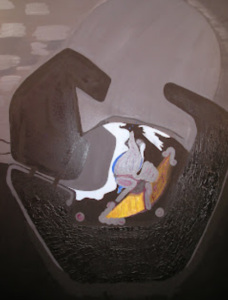
In that eternal darkness the abyss folds in on itself, collapsing infinities of deathly despair, hopelessness, and evil, lifelessness, where we eternally abide alone with our self induced pain, agony. We will have to own that "singularity" which we squandered our lives to reach and it is not going to be pretty after all. If only we recall before its too late what might have been had we taken the opportunity to follow the one true path of humility and selflessness. You know, those primitive notions.

We might see this now if only we weren't so blinded by our moral relativism, our virtue signaling - a form of evangelism, from that missionary spirit, isn't it? It says "I am holier than thou" so take heed of my new improved puritanism. It is a crisis of conscience that there is now a universal repugnance in western culture - Christian culture - to condemn anyone's lifestyle no matter how outrageous. We wouldn't want to hurt anyone's feelings, right? We have given up ownership of any morality whatsoever when we are forced to celebrate deviant behavior, wantonness, because, you know, everything is allowed, therefore  judgment, condemnation of anything at all is to be censured. I'd like to know when we decided that the "elevation of choice over all other human goods" was how we would proceed. This is the "absolutization of autonomy" that now dictates how we react to outrageous behavior. What, I ask, happened to moderation? It is a quantum leap from "tolerance of difference and diversity to the celebration of difference and diversity." (Quotes from here)

Hope in vain that the societal tendencies providing for this "woke" dystopia will eventually be depleted of their energy and subside. This is a natural extension of "spreading the gospel" as modified by worship of the machine we've created to replace God. Wokeness is, then, a kind of theology. It says, for its adherents, "I own the truth" and the truth is whatever I say it is. They are full of certitude, ego-centrism again. They own God, indeed, made him again with their own hands. They believe they have every right to make everyone see the truth as they see it, for their own good, you see. They would annihlate those who oppose them. There's no humility yet their frustration will eventually manifest as seeking for a leader, a savior; their actions speak to a nascent longing for such. They despair, have the sickness unto death, are filled with self-loathing - that's why they mutilate themselves. But surely, they'll never admit their hopelessness is of their own making. It's always the fault of those who haven't yet been converted. They seek eternally to transfer their despair to an agency outside their control. They are nihilists in the truest sense.

[caption id="attachment_676" align="alignnone" width="210"] William Blake - from "Europe, a Prophecy"[/caption]
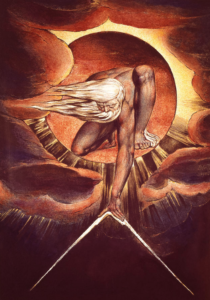
Its axiomatic that the fundamental premise underlying the Age of Reason, it's grossest manifestation, the Industrial Revolution, is that everything can be explained, measured, and ultimately known - eventually. However, this is the opposite of the truth.

That's why we've no sense of belonging as did ancient peoples. We've sacrificed our sense of belonging to time, to place, for being a mere extension of the machine God we've made. We belong to that ever disappearing over the horizon singularity when knowledge reaches infinitude. No wonder primitives were better adjusted, lived a more fulfilling life. We are totally bereft of Mystery; there simply is no mystery that can't be solved for those embedded in the Age of Reason and its outcroppings. For our forbears it was all mystery and you accepted this and that acceptance made you complete. Being complete made you happy.

Until the Greeks man was at the complete mercy of the unknown. It was then that Protagoras famously claimed that "man is the measure of all things." Thus began our estrangement; thus we took the first tentative steps toward being a "stranger in a strange land." I imagine about the same time we began looking for a savior. Protagoras was a 5th century BC man, So, the bronze age.

So, the way home? We missed it many centuries past and our evolution has surely confounded the absence. There are esoteric teachings. The quote from Blake and Plato above touch these. These are worthy of Jesus and Buddha but while Buddha did talk like this on occasion, Jesus didn't, at least not as reported in the Christian Bible; it takes a special gift to get to the deeper meanings of the biblical writings. Jesus' teaching, for the most part, seems tailored for the most common people notwithstanding the presence here and there of the profoundest thoughts on being and meaning and purpose. Jesus was everyman's Lord. The evolved missionary spirit is a corruption thereof; it's teaching leads to self loathing, guilt, despair. Fear and trembling are its hallmarks. There's no exit. Your condemnation owns you yet you would save the world. Better to merely save yourself by taking ownership of same. Instead we intend that global capitalism, progress, will save us as before we intended that reason would. The Spanish conquistadors intended saving the (Comanche) Indians. Now they are as good as gone except for a few dusty old books. I here repeat the notion that has been advanced for millennia that one will appear that will appeal anew to all but that one will not issue from the good. No. It knows that we've made a Faustian bargain. That will be taken advantage of in the extreme in what is to come. If we fall for what we have now we'll clearly fall for anything. In an infinite universe whatever at all is possible will eventuate. Want monsters? We'll get them without some basis for boundaries.

There is a primitive creature, a worm, whose genes we have mapped. (I can't find the reference to this but I got it from a talk by Sean Carroll, Astrophysicist.) One gene's function is to tell the creature "this is my tail - don't eat it." Mankind has somehow willfully, blindly,  misplaced that gene. Is this out of malice, ignorance, an agency working through us to promote our self destruction, i.e., evil. I'd be the first to admit I truly do not know, indeed, can't know. Its as much a mystery to me as the spirit that lives in a spring is for a primitive. I just accept it and try to make do with what's at hand. That would be understanding, noesis. I've given up on knowing a long time past....and, oh yes, I leave it to the divine mystery that actually owns it.

This great mystery in which we find ourselves is not, after all, knowable for it is a mystery to be discovered in the sense that discovery is the action of the unknown. In relinquising ownership of that mystery we come, at last, into our true nature. We own nothing. Its all void, all the way down.  We don't even own ourselves. We are mere motes in the eye of that which sends us. And yet. And yet! Somehow we give purpose and meaning to the world. Be humble!

Dream not of transcendence. Pure fantasy. Dream rather that "deeds cannot dream what dreams can do—time is a tree (this life one leaf)."

Saturday, May 28, 2022

Contrasting World Views


Desani: If there was only one religion you would only have a partial view [of being/reality]

Co-creator - Rabbinic Judaism

Means by which world has self experience, knows itself - Distillation of Hinduism by G.V. Desani

Sinner who must be saved - Christianity

There is truth in all of the above. The idea that we are partners with the divine as co-creators merges with the idea that we are the means by which the world has self experience; God descends into matter in order to re-emerge a self realized being. That is the story of Jesus. In a sense Jesus is everyman, then. But pride inhibits this unfolding and is the sin from which we must evolve in order to be who we really are. Saved from our sin is to give up our will, humble ourselves before the divine creative spirit. It is expressed as "Take up your cross and follow me." Give up your will to mine, is what that means. Then our life is no longer ours but "his", our father's. God, the creator then lives through us. If the will, our little will, is triumphant, then the self, our little self, won't humble itself and we will continue as slaves to our passions, or worse, if one believes in demon possession. The path most, in the Western world, are on leads to self-loathing as we struggle in vain to shed this guilt which has been inculcated into us for two thousand years. Instead of understanding it for what it is, a key to redemption, we sublimate it only to have it continuously crop up in every aspect of our lives.

Be like the bamboo leaf on which snow accumulates until the leaf gives way and the snow slips off. It follows its own nature without effort, without willing. There is no will involved whatsoever. The leaf surrenders to the weight of the snow flakes flawlessly; the Beauty of this is ineffable.

Surrender to God is in the Hindu's Gita. So is love of God (Bhakta) and ritualized worship. Self denial, asceticism, is there too. Judaism, Hinduism, Christianity seem to have appealed in ancient times to a common undercurrent. What they commonly teach distills down to what, in Yoga, is called "inhibition of the citta vritis". Suppression of the modifications of the mind. That would, of course be Patanjali's first sutra on the nature and meaning of Yoga in his Yoga Sutras. Inhibition of modifications of the mind, or consciousness, could be viewed as surrender to God and is intended to accelerate the realization that we finite beings point to the infinite, are made in the image of all that is; we are sparks of the divine, it is taught. As David Goldman puts it in his Beethoven essay, the infinite is ever present and appearances always point to it as that is where the infinite, so to speak, hides. So, God is omnireal, omnipresent and there is no finite absent the infinite. This is similar to there being no light absent darkness, no good absent evil, no positive absent the negative. There are contrasting pairs, aspects, of reality everywhere.

Failing to realize these points is a spin off of our diabolical endeavor to build a machine to replace God; call it the "web", the "interNET". It is, at least, intended to be all providing (Amazon), Omniscient (Wikipedia, e.g.), and Omnipresent (Google, et al), Omnipotent (the State). It is infinitely malleable; we make it whatever we want and call it good but I think it likely is the opposite. We've made a Faustian bargain? And this machine god is ruthless, takes a terrible toll among the impressionable young. Should we encourage the measurement of the value of one's life on facebook likes, on re-tweets, up and down votes?

Sixty years ago I lived, as a young soldier, in Gablingen Kaserne. It was an old barracks used formerly, during WWII, by the German Wehrmacht. I was a soldier, an Infantryman. Looking back on that, taking its measure from long perspective, I now realize that likely those couple of years were the best of my life. That young soldier would think me crazy for saying this now. He was so full of himself, of longing, of ambition, restlessness, eagerness. He never, or hardly ever, saw himself for what he was. Yes, he'd been brought up right, had good parenting, learned the religious things they taught then, which he mostly rejected being so self absorbed. He didn't know it but he was like a bird fluttering over the abyss.  Now I'm still that bird but the abyss has grown to infinite proportions. If someone had told him the way to understand, simply put, what I have written here and elsewhere is to realize that man confers on God individuality and in return God confers on man universality That is a simple truth and is, I believe, the true story of Jesus. Put a bit differently, the story of Jesus is intended to teach that man, at least potentially, displays the attributes of God. As co-creator he even has the power to replace God with a machine and worship that. Realizing this is near impossible, because, of course, we are mired in our "sin" which, that young man would never understand, means simply that we cling to our will at all cost. Given this being we manage continuously to corrupt it in ever new and shiny ways. The web tangles us the more in that net.

History is pressing us forward. We are on a journey through unfolding cultural epochs. The transition from one to the next is anything but seamless. The features fractalize, get corrupted, intentions take on a life of their own in spite of whether they were good or bad. They morph, combine, bubble up out of the mire and forever sprout evolving manifestations of themselves. First we lived as artists, artisans, primitavely assemblying our world mainly into questions about who we were, what this was that we found ourselves in. Art asks questions but expects no answers but soon our questions led to primitive answers about purpose and meaning and we merged into the succeding epoch, religion which had the answers putting them above man in a separate realm called heaven with God as custodian. Reality was perfect above, beyond man, and corrupt below. It was an Aristotleian view of the world. That morphed into science - we were only three steps removed from our beginning where the impossible to access answers as to meaning and purpose continues to be beyond us in the sense it perpetually awaits explication in a "grand unifying theory". One theory creates ever successive opportunities for new and better explanations of how things fit together in an assumed mechanistic universe. Science enhances our material nature and we become ever more enslaved by it thereby but history as cultural epoch comes to us now and further emphasizes the material aspect of being. We theorize that history shows the way logically by steps through a heuristic and dialectic process, a recursive and infinite regress for the betterment of mankind's lot. As in Religion and Science, in History we similarly a final synthesis to be reached on a perpetually vanishing horizon that we somehow can neveer quite reach. This is where we are now. In these epochs consciousness is directed out from us into the world. The West having learned through Christianity to "spread the good word" continues that missionary zeal with endless meddling in other people's affairs "for their own good" - in short, the historical effort to colonize continues with zeal the evangelists of old would admire. Some even say we are now colonizing ourself. Now, if only we could connect everyone somehow with a live system that is always on we would have achieved history's wildest dream as everyone merges into The Hive with the necessary loss, of course, of any individuality. In The Hive Sobran says that like an Hive bound insect one loses the need for a soul of one's own. That's the cost of being in the collective. In the ancient Vedas it is written that "Knowing your own self (soul) you know the soul of the Universe." Its of paramount importance to guard your individuality though we are almost to the point of totaly losing ours. Only a few luddites, old people, stand in the way and of course we know how to deal with those. War, famine, divisiveness, not to speak of custom made pandemics and fear, are useful tools in this. There are too many people anyhow.

To recap, the crowning achievement of these cultural epochs was the industrial revolution. The industrial revolutin is evolving into total interconnectivity, interdependence of all mankind when this material machine completely replaces God. Our primitive man would rebel against this intuitively. But Religion, Science, and History could care less. Reason  finally has its triumph as it gloats over its great achievement of destroying man. Thing about a dystopia is everyone is on the same page, everything finally makes sense and is in logical order whatevere it costs. But, there will be another epoch sprouting out of this, to be sure.

Eratosthenes (276-194BC) in Syene Egypt, now Aswan, discovered the circumference of Earth. It was measured in Stadia, based on the size of the then current Greek unit of length. From that was calculated the diameter of the Earth, about 8,000 miles. Now, in astronomical terms that is indeed a tiny thing. We live on a planet that is likely almost impossible to detect outside the solar system. The earth/sun orbits its center of mass which is deep inside the sun. We are barely here, unknown, alone in the abyss of space. What are we doing to earn our keep? Oh, we are kept, make no doubt about it. By what/whom is unknowable to us but we are, it seems, somewhat sentient life forms. If there is a purpose and meaning we might come to have at least a rudimentary understanding of it. The first step should be to humbly accept what we truly are and that is decidedly not the author of our own inheritance of this tiny dirt ball we call planet Earth. Think about this. Until we came along as sentient life forms there was no beauty, truth, love, understanding, wisdom, or any concomitant of consciousness whatsoever. Our emergence as living beings capable of self understanding was a precursor event for the emergence of these values or faculties. What is unfolding here? What further emergence will these precipitate? Could it be the divine itself? Or, have we perhaps reached our credit limit?

Consiousness is heretofore directed outwards. What would be the consequence of somehow managing to have it - realize it -as returning on itself?

I'm grateful for Paul Kingsnorth whose writings I've lately been studying for inspiring me to write this entry.

Monday, April 25, 2022

Concerning U Chan Htoon's paper on Buddhism

 Blaise Pascal, Pensee number 84: It is with rash insolence that we belittle the great to our own measure, as when talking of God.

Matthew 11:27 Neither doeth anyone know the Father, but the son, and he to whom it shall please the son to reveal him.

Matthew 7:7 Those who seek God find him.

We live on a planet orbiting what is known as a main sequence star, that is, rather common place. Our sun orbits the galactic center and is imbedded in a so called arm of its galaxy; the Milky Way galaxy. The Milky Way is a spiral galaxy. It has several arms and is disk shaped with a bulge at the center. The approximate distance from the sun to the center of the galaxy is about 26,600 light years. (When I studied astronomy some years ago that number was thought to be 30,000.) The diameter of the whole system is approximately 100,000 light years. It takes 225 million years for the sun to complete an orbit around the center of the galaxy. Now the sun, as a main sequence type star, has an expected life span of nine billion years of which it has lived about half. That means that it has completed about 20 orbits and has about the same number to go during its remaining life. The Milky Way contains between 100 and 400 billion stars.(A 2020 article on this.)

That gives a little perspective to what follows, I hope. Everything I know, understand, and so forth, is nothing more than a fly speck on the moon. So, as is said nowadays, your mileage may vary. I certainly have no more standing than anyone else to comment on the subject matter at hand. It is by the Lord's blessing, I suppose, that I have such inclinations in the first place.

U Chan Htoon, former Justice of the Burmese high court, spoke to the Sixteenth Congress of the International Association for Religious Freedom at the University of Chicago, August 12th, 1958. In 1961 G.V. Desani delivered the lecture "Vipassana Bhavana, Yoga, and Other Topics" to the diplomatic corp at the Israeli ambassador's residence in Rangoon, Burma. Justice Htoon was in attendance.

In Buddhism we try to avoid the use of the word "spirit" because this may be taken to imply some kind of enduring entity...

He then goes on to claim it should be understood, rather, as a psychic process. I take this to mean it does not endure except in a (local) relativity-complex in the same sense that for movement (of bodies) to exist there must be a multiplicity of "bodies", that is, more than one. Movement is relative only. More on this later.

It is further stated that "...rebirth is not the reincarnation of a "soul" after death, but more precisely it is the continuation of a current of cause and effect from one life to another. There is nothing in the universe that is not subject to change, and so there is no static entity which can be called a "soul". A being is the totality of five factors; material, the physical body, sensations, perceptions, volitions, and consciousness. "All these factors are undergoing change from moment to moment and are linked together only by the causal law - the law that 'this having been, that comes to be.' Hence Buddhist philosophy regards a being not as an enduring entity but as a dynamic process."

He goes on the claim that Nibbana is permanent and characterizes it as release from the realm of becoming, samsara. It has no qualities, no relative values which always require, what he calls a "relativity-complex". Positive and negative attributes depend on one another for their existence, for instance. Also, light(ness) and dark(ness) being opposite poles of a "relativity_complex" depend on one another for their existence, too. Neither is absolute. In the Desani lecture cited above the claim is also made that Nibbana (Nirvana) is permanent.

Michelson and his colleague Morely, tried to establsh the absolute existence of the aether. Many thought at the time that it was required to have a universal medium whereby light was propogated. He found instead that the aether did not exist. Subsequently Albert Einstein explained that the speed of light was dependent on the (an) observer. The speed of light is only relative to an observer. Einstein also said, relevant to this, that there is no natural rest-frame in the universe. This leads me to speculate that were the universe a single body light would not exist, just as movement wouldn't. There must be that relativty-complex. Also, I find it interesting that Einstein wrote, per Mr. Htoon, that "if there is any religion that is acceptable to the modern scientific mind, it is Buddhism." I tend to claim, however, that Buddhism is not a religion because there is no personal God. Buddha never claimed to be a Lord or God in the flesh. Jesus was circumspect in this. He did say "I am the truth, the life, and the way. No man cometh to the father except by me." Also, "Believest thou not that I am the Father, and the Father in me? The words that I speak unto you I speak not of myself: but the Father that dwelleth in me..." John 14.

Commentary:
God can't have self experience without descending into matter and assuming corporeal form(s). The "Word" is made flesh in order that God, the Divine creative spirit can have self knowledge. That is, in this writer's mind, the purpose and meaning of life. The story of Jesus Christ is a metaphor for this. And, of course, the so called "relativity-complex" of Justice Htoon is required for this. This writer makes an assumption that the actual stuff of which we are made, the same as the sun, of course, has a kind of self awareness based on sentient forms compounded of the same stuff.

Furthermore, its my premise that U. Chan Htoon didn't fully understand Judaism and Christianity. Consider Exodus (the Bible), Moses asks God "Who shall I say sent me?" Tell them, God replies, "I Am sends you." Being itself sends you. I don't find anything corresponding to this in the lecture.

So, the meaning of Jesus; God descends into matter in order to "re-emerge" an enlightened (fully self realised) being. Why wouldn't one say the same of the Buddha? and that such beings, all sentient life for that matter, become, along the way, co-creators of the Real, the world. Certainly, it is put forward that Jesus was in hypostatic union with God, the Father. Why couldn't the same be said for Buddha; 100% man but 100% God, too? Wasn't he an Jagatguru? Having escaped impermanence in the permanence of Nibbana would one be considered to have also reached the seemingly impossible hypostatic union with the Divine creative spirit, or whatever you want to call it? Would that bit of the sun stuff of which we have the pleasure to be co-compounded realised once and for all exactly what it is? That fly speck? One would needs discover this for oneself.

Said another way, man (sentient life forms) supplies the cosmos with individuality while the cosmos gives man, in return, universality. Enlightened beings realise this whether said explicityly or no. This from my mentor. And this, too, seems relevant: "where the concentration is, there is the persistent, the lasting, the permanent. That to which attention goes is that which returns. In a sense to attend to something is to put consciousness into it, to bring it to life, to self awareness." Put another way, if there is no observer there is nothing. Also,the recursive process that results in rebirth must be said to gain in vitality by the concentration, self awareness, of the successive lives so attached.

Kamma or Karma, as well as the precept that nothing endures, is permanent, and thus, there is no "soul" that carries forward through successive lives, is best understood, I think, when the Real, the world, is considered as a recursive phenomenon. Recursion, the Fibonacci sequence is the best example I know - 0,1,1,2,3,5,8,13..... - Zero is the still point, of course, wherefrom the "beginning". It is necessary for any meaning or understanding whatsoever. So, every instance of the Real is a product of the preceding (instances). It is a fractal wherein knowing the still point you know it all. Yes, its a mystery but, clearly, out of nothing comes nothing (Ex nihil, nihil fit). This is why its impossible to explain, why the talk about the ultimate having no attributes, why when the journey is completed one arrives at the beginning but knows the place for the first time. Something happens during the process, the journey! Consciousness? Moreso, all that is happening now added to all that has ever happened equals all that will ever happen. This is, to me, how karma can be grasped. To recap, the purpose of the existence of the elements of recursion in the "relativity-complex" is to source new instances which have no permanence in themselves. They are made to fade. The process, however, is a kind of permanence in the same sense that a river, though ever changing, remains the river, and the instances, drops of water, merge eventually into the sea through ever widening banks. Poetically, they widen to embrace the sea.

Further, as Desani puts it here, For whatever activity undertaken, there is a spirit for that doing and that spirit in time gets a life of its own, gets self awareness as it goes on. These acts eventually become forms of worship. Doing good enhances goodness. Goodness is the reservoir drawn from when acts of kindness are done. And it is thereby increased. These acts are like accretions. Charity grows by use. Doing right this time makes it easier the next and so forth. Of course, it works the same for evil doers. A murderer draws on a different kind of reservoir to do his evil. His evil adds to that and the next time it is easier to follow that path. Evil begats evil, one reaps what one sows. It works that way. Love, Beauty, Truth, begat more of the same, too.

The lecture's full title is Buddhism and the age of Science. I can't find it on the net except to purchase but my copy is a Wheel Publication No. 36/37.

This writer's view is quite different especially concerning what is said about Science. I think they fail to understand Science and its place in the total scheme of human endeavors. I see it, as did Philosopher R.G. Collingwood, as an emergent phenomenon along with art, religion, and other modalities of being in the world. Collingwood's scheme compares to Soren Kierkegaard's in that Kierkegaard views faith as such a mode of being. Art, religion, science, history, then philosophy is how Collingwood describes the recursion of these modalities.

It is philosophy that Collingwood thought was the natural culmination of the preceding elements. He describes them in detail, their successes and failings. Here, I write of his work in this regard. Soren Kierkegaard's work is much more difficult to grasp but I go into it to. Here.

I said above that Buddhism could be thought of as not being a religion in the sense of Judaism, Christianity, Hinduism, and so on. Perhaps it could be better understood as coming after philosophy in Collingwood's progression, after faith in Kierkegaard's. If these modes, art and the rest, are truly like the Fibonacci sequence then philosophy is not the final element; neither would Buddhism be were it included. The Sun is, after all, middle aged. Having 20 more orbits to make around the Milky Way, 20 more galactic years to live, I'd imagine we'll have ample opportunity to plumb the depths of Reality's infinite malleability.

Collingwood describes philosophy as "consciousness returning on itself"; like a fountain. Pretty image. I think it is a prototype of what Buddhism and, also, the esoteric teachings of the yogis, is. My mentor's writings give the best jumping off place for what might be the next big thing in mental culture.

In working this up I am indebted to David Warren and his piece on God's Existence, here. I love this quote: "For science, or human knowledge more broadly, God is not an hypothesis, but an Axiom. Start in Aristotle, if you will, to see that the world has no purchase on sense, without the Unmoved Mover. The “Five Ways” by which the inevitability of God was demonstrated by Thomas Aquinas, and the related ways in which this was done by others before and after him, are easily misunderstood, because they are not proofs of an hypothesis but recursions. They show, without the “God Axiom,” that there can be no causation, no change, no being in itself, no gradation, no direction to an end. We need a Still Point, from which to depart. It cannot be hypothesized. It is too simple for that. You need to assume it even to contradict it."

Finally, I write here about entelechy, the end within. According to Buddhist thought there is no end, no beginning, only the process has any claim on reality. So, any end within dependes on a local framework, a relativity-complex, in Mr. Htoon's usage. I'd put forward that if you must have a concept of the end within then go with Mr. T.S. Eliot's beautiful notion that after all our struggles, trouble, turmoil, conquests, losses, "we arrive where we started but know the place for the first time."

Notes extracted from my "A Plus Notebook" which also contains notes on Don Juanism from Poteat's class

 Desani, March 14, 1973

Burn the seeds (of deeds) by high samadhi only. The weakened klesa is stronger than the klesas/passion full blown because its expression is more subtle, harder to root out because they are harder to recognize.

Margin note here that I got Texas tags today; quit moving houses. March 21, 1973. This means I retagged the 72 Chevy yellow van that I bought in Virginia and that I no longer worked with Jerry Sires. This leaves some confusion in my mind because I thought we finished moving houses prior to my purchase in VA. of the van. Maybe it means I quit "leveling" houses with Jerry.

Now the notes.

Heavy Karma is in the mind. There is a diagram here, a circle with a small area at the top delineated as "fixed destiny" while the larger area is labeled "unseen karma". This unseen karma it is noted, consists of inumerable past deeds, words, lives.

The desiring of an object is animalistic.

Clinging to an object is equivalent to fear of losing same.

Fear is equivalent to guilt. Or rather, their natures are intimately entwined. (This is not attributable to Desani. It is mine.)

If one tends to animalism one eventually falls into violent experiences, employment, etc. For instance, the proliferation of armaments.

A sanskara is an unaccountable karmasaya.

Important: To have a spiritual mentor is a fixed destiny.

Attachment (is related to) revulsion.

A selfless action is a virtuous action.
Duty, not? intention, with love, with compassion.

Desani spent five years learning to walk without intention. It is exceedingly difficult, he said.

Restraints must be imposed on things that are easily overindulged in, for instance, sex.

My aside: Desani is a composer, a maestro, a conductor. He draws ideas, words, etc., into a mosaic.

When sattva rises to its highest level illumination is produced (in a situation).

There is a need to rise above the sweet and the bitter experience; there is a reward.

Told story about being in Burma, about yogis, hills, snakes, very large mosquitoes, AHIMSA (non violence). Desani reformed - first "clean" room - for a smooth pursuit of practice.

"The Science of Yoga"
I.K. Taimini

Sutra is an aphorism. (Patanjali's Yoga Sutras are aphorisms.)

First sutra: Yoga is control of the vriti, modifications, of citta, consciousness.

Patanjali was the compiler of yoga, an ancient tradition. (Later note: He was a retainer of a King I expect somewhat like the European Kings retained astronomers, mathematicians, etc.)

The Gita notes there are many yogas. The sage Patanjali's yoga is a precursor of these:

Raja yoga
Dhyana/Zen yoga
Karma yoga - yoga of action (without desire)
Bhakti yoga - yoga of devotion - like a practiciing Christian's love for his God. This would be Krsna.
Hatha yoga - physical yoga
Kundalina yoga

Samkhya is the theoretical basis of yoga.

The yogi seeks quiesence in order to attain samadhi or satori.

The philosophy derived from the yoga sutras is outlined thus:

Here a chart is drawn showing two realities. On the left is Purusha or spirit and on the right is Prakriti or existential mass, the substance of the universe, nature. Prakriti consists, with reservations, of three elements known as the gunas. They are Sattva, Rajas, and Tamas. (see below)

A line extends downward through Mahat, cosmic intelligence and then to Ahamkara, the principle of individuality, of "I am".

A margin note here explains that the first product of the union of Purusha and Prakriti is Mahat.

Below Ahamkara comes Manas, the cosmic mind. Below Manas the chart branches into, on the left, Indriyas, the power of the senses, hearing, smelling, seeing, etc., and on the right the Tanmatras or subtle elements of sound, odor, visibility, etc.

Another margin note explains that it is from the Mahat that Patanjali intellectualized his compilaton. It is also the Mahat that westerners allude to when they speak of universal mind.

That is the chart.

Consciousness is made of, consists of (the) three gunas. A rose is made of the gunas. The "image" of a rose in one's mind is made of the gunas. The difference is, with some reservations, a matter of quantity.

Sattva is the most subtle substance in nature. It is mental substance. On the moral level it is goodness. On the aesthetic level it is the most beautiful.

Rajas is the animating element.

Tamas is the passive element, the tendency to procrastinate is tied in with Tamas. It is also the steadying element. It pulls toward sleep.

Yoga has to do with the second guna, with stopping the animating element so that Sattva can shine forth. This is the quieting of consciousness.

Samadhi grants mokti, freedom. There are different levels of Samadhi. (page 41 of book)

Incomplete note on Samprajnatta (sp.) Samadhi.

There are five kinds of citta vritis.
1. A person feels full of lethargy, sleepy. Sattva and rajas are conquered by tamas. (The god's never sleep and Desani, as monk, went ten or so days with no sleep. In this condition sattva reigns.)
2. Full of anger, tamas dominates.
3. Full of restlessness, rajas dominates.
4. Full of good works, Sattva dominates.
5. The highest Samadhi is the one that grants knowledge.

We have Purusha, or spirit on the one hand and Prakriti, cosmic substance on the other.

Yoga means union or yoke. The first result of the union or yoking of spirit and cosmic substance is cosmic intelligence.

On foreknowledge, a side note on the Nadi shastras, he said that two centuries ago on palm leaf [was written references] to Desani by name. It gives date of birth, place, and so forth. More on this here.

Qualities of Purusha: It is the Lord. It is not material. It is conscious.

Qualities of Prakriti: Sattva, mental substance, Raja, activating element, Tamas, inertia.

A 2500 year old commentary says that space and time are schemes for the understanding.

In Mahat Sattva dominates. Mahat is the source of wisdom. Mahat is the first evolute. Literally mahat means the great.

When Purusha and Prakriti are joined and the first evolute arises it is Purusha who sees this. It is Purusha that sees all.

Ahamkara is the precondition for the mind's ability to discriminate. At Mahat there is no discrimination but just an ocean of light. (A thought that most people evolve to Ahamkara and stop, especially westerners.)

Yoga is the stilling of cita vritties, of modifications of consciousness.

(Yoga nirodha citta vritti.)

Consciousness is material so what we think effects others. Thought empinges on the object of thought: Highly advanced yogi might think of a person as dead that person will find his death. If I think good..... Desani has seen it.

Thought is substance. Think Sattva will increase, it will. Think Raja as increasing, it will. Think Tamas as increasing and it will. Example of a teacher at Cambridge hitting a student who questioned whether thought could be proved to be a substance in the stomach with a visualized (by thought) heavy object. Desmond hit his student, turned, whirled to face student. The student fell, was hospitalized, almost died. Desani said this was a petty trick. Also a man worked ten years to perfect a trick whereby he could not be moved by five men from a train he refused to pay for. He thought heavy object into existence at the base of his spine. That is, he cultivated Tamas at the base of his spine.

There are four states of consciousness. Awake, sleep, profound sleep, Samadhi.

One must practice and practice detachment.

The intellect is material. If it is mirror like, superior material, it is comprised mostly of Sattva.

Purusha is masculine, the divine father. Prakriti is feminine, the divine mother.

Gita and Rabbinic Philosophy, and Lieb, and others

 This is a workup which I might edit later.

Irwin Lieb, formerly Chairman of the University of Texas at Austin Philosophy Department, and my professor, stated that the only individual is the entire Universe itself. We are only nominally individuals, he said.

Vedas: Soul of man is same as soul of universe

(Svetasvatara) Upanishad: He is not a male, He is not a female,He is not a neuter. He neither is nor is not. When He is sought He will take the form in which He is sought, and again He will not come in such a form. ... It is indeed difficult to describe the Name of the Lord.

Buddhism: There is no soul; there is nothing permanent.

Christian Bible (Exodus): Tell them "I Am" sends you (to Moses)

Albert Einstein: Speed of light depends on the "observer".

(How to resolve these)

Rabbinic: Man is in partnership with "maker of heaven" in the continuing work of creation

Compare Rig Veda 10.129 with Parmenides (see David Goldman)

Compare this to Gita/Vedas: For the Greeks, time is the demarcation of events. But in Hebrew time, it is the moment itself that remains imperceptible. As Kohelet 3:15 states: “That which is, already has been; and that which is to be has already been; and only God can find the fleeting moment.” From David Goldman

Soloveitchik, "Lonely Man of Faith": at end, pgs. 59 on he succinctly characterizes the dilemma of modern man in terms that have a ring of truth. Could compare to Rougemont and Kierkegaard, e.g. Compare also with Bhagavad Gita's characterization of "man of faith", or, as Soloveitchik terms him, "Adam the second". "Faith is born of the intrusion of eternity upon temporality....Faith is experienced not as a product of some emergent evolutionary process..."

So I guess this might mean, contrary to what I have thought, it isn't a concomitant of consciousness?  I don't understand how eternity can be an an intrusion at all. I think the temporal is as likely as not designed to make eternity meaningful.

Goldman on Beethoven and the sublime: "The Sublime challenges us to conceive of something that transcends the way we process sense information. Because the Sublime demands our intellectual response, it evokes freedom: We are not the passive observer of fixed and limited phenomena, but the artist’s collaborator in the recreation of the art work. We must lift our spiritual level to engage it."

Goldman applies Soloveitchik's thesis here that "Man is in partnership with the "maker of heaven" in the continuing work of creation."

The Jews were brought out of Egypt, bondage, crossed a river via a miracle. Americans were brought out of the Old World, escaping servitude, crossed an ocean, resumed their journey across the continent, seeking an ever escaping redemption.

On reading Milton Rothman's "The Laws of Physics" and Bishop George Berkely's theories on motion:

"There is motion only in relation between objects."

Apply to understanding and knowledge.

Knowledge is always of the "other"; only in relation between objects.

Understanding, on the other hand, does not require multiplicity. See (Nous) Noesis, intuition. Understanding is reflexive, consciousness returning on itself, R.G. Collingwood. Only when multiplicity is dropped can understanding arise. Apply this to Goldman on Beethoven, above. Understanding is sublime, is the finest exemplar of true Freedom. It is transcendence. It is not a thing but a verb. It is merging of the soul of man with the "I Am" of Exodus. The state of passive observation of "fixed and limited phenomena" must be dropped, pass away. Only then can the "I Am" take the forefront. Only then can we truly exercise collaboration with Being, with the Art of a Beethoven, the Philosophy of a Soloveitchik or a LIeb.